
Fuse Web Design › Guides for businesses · Español
Spanish Speaking Dentist Near Me: why one line in the footer isn't enough
According to Census Bureau data (2019-2023), 47.8% of Pembroke Pines and 65.5% of Kendall identify as Hispanic or Latino, and more than half of each area speaks a language other than English at home, overwhelmingly Spanish. No Florida law requires a bilingual website (we checked statute 456.062, Board of Dentistry rule 64B5-4.002, and statute 381.026, and none of them apply to a dental practice or its website). But a real bilingual website, with a full Spanish-language page written to rank for Spanish searches, Spanish-language appointment booking, and Spanish-language forms, is the difference between showing up or not when someone searches “spanish speaking dentist near me.”
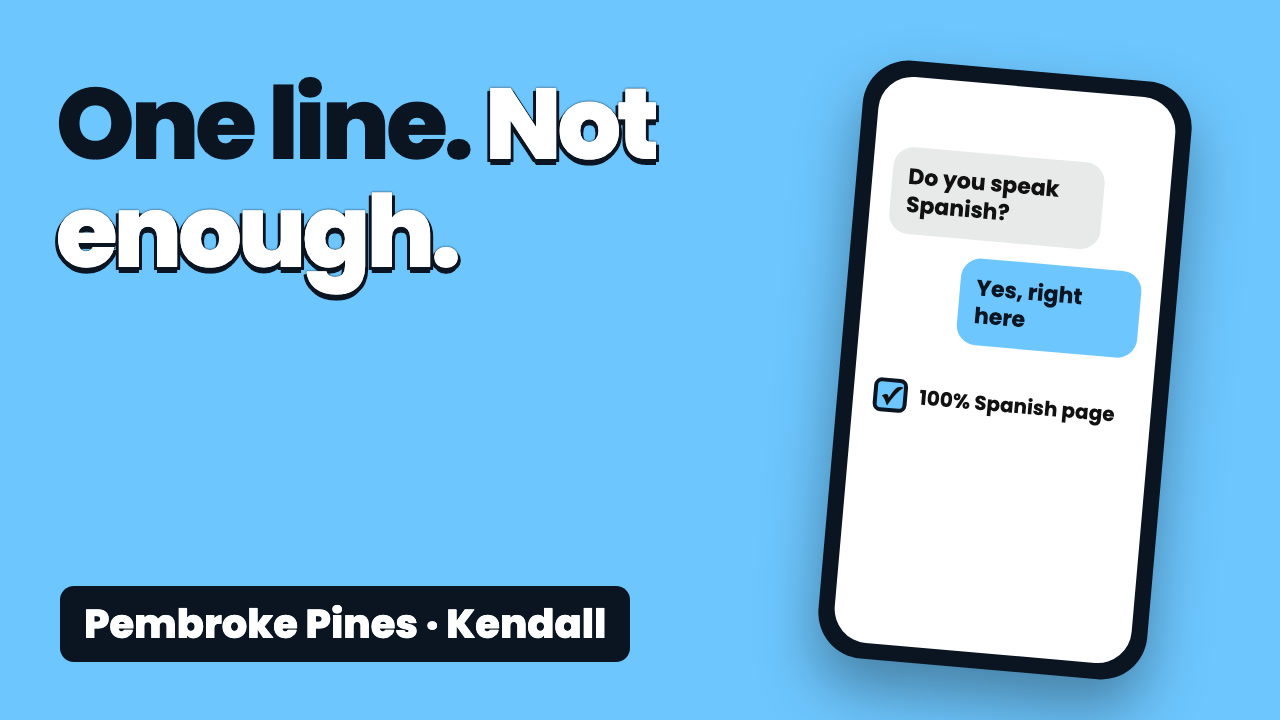
What actually makes a website bilingual
1. The real size of the market
According to the Census Bureau (2019-2023), 47.8% of Pembroke Pines and 65.5% of Kendall identify as Hispanic or Latino, and more than half of each area speaks a language other than English at home.
2. A Spanish page that actually shows up in search
Not a Google-translated clone: a version written to rank for Spanish searches, with your own keywords.
3. Appointment booking in Spanish
The patient should be able to book an appointment start to finish in Spanish, without switching languages halfway through.
4. Intake forms in Spanish
Intake and consent, not just the homepage, also in Spanish.
5. It's not a law, it's an opportunity
We checked statute 456.062, Florida Board of Dentistry rule 64B5-4.002, and statute 381.026: none of them require a bilingual website. This is about not losing patients, not about complying with a law.
Want to check your whole Google profile in 15 minutes? See our guide: Google Business Profile checklist in 15 minutes.
We'll build you a free bilingual mockup of your website
You see it yourself: your site, with a real Spanish version.
- We show you how your site would look in Spanish
- No commitment, no call
Frequently asked questions
Why isn't “we speak Spanish” on my website enough?
Because that one line doesn't help people find you when they search in Spanish, doesn't let them book an appointment in Spanish, and doesn't cover your intake forms. A real bilingual website has all three.
How big is the Spanish-speaking market in Pembroke Pines and Kendall?
According to Census Bureau data (2019-2023), 47.8% of Pembroke Pines and 65.5% of Kendall identify as Hispanic or Latino, and more than half of each area speaks a language other than English at home, overwhelmingly Spanish.
Does any Florida law require a bilingual website?
No. We checked statute 456.062 (free/discount-ad notice), Board of Dentistry rule 64B5-4.002, and statute 381.026 (interpreter right, which applies only to hospitals and certain physician-type facilities, not dental practices or websites). None of them require a bilingual website.
Is a Google-translated version of my site good enough?
No. An automatic translation isn't written with the words a patient searching in Spanish actually uses, so it almost never shows up in those searches. A real bilingual website is written with those searches in mind from the start.
Does appointment booking need to be in Spanish too?
Yes. If a patient starts booking in Spanish and the system switches to English halfway through, many give up. The same goes for intake and consent forms.
How do I request the free mockup?
Text us on WhatsApp or fill out the form on this page. We'll show you what your website would look like with a real bilingual version, no commitment.
Official sources
- U.S. Census Bureau QuickFacts: Pembroke Pines city, Florida
- U.S. Census Bureau QuickFacts: Kendall CDP, Florida
- Florida Statute 456.062
- Florida Administrative Code 64B5-4.002, Board of Dentistry
- Florida Statute 381.026
We're not lawyers. This guide is general information, not legal advice or a guarantee of results.